


Adventist Health Lodi Memorial: Eighty Years of History
By Frankcarlo Mills, for the San Joaquin County Historical Museum
Photos courtesy of San Joaquin County Historical Museum
Almost everyone in Lodi is familiar with Lodi Memorial Hospital and Adventist Health, but their presence in Lodi, as invaluable as it has been to our community’s wellbeing, would not have been possible if the people of Lodi had not decided that the town needed its own public hospital. In the wake of World War II, Oscar Ditmanson and Vincent Webb, local members of the Disabled American Veterans, formed a committee to build a local hospital. Their efforts led the construction of Lodi Memorial Hospital, our town’s first public hospital and vital pillar of local healthcare.
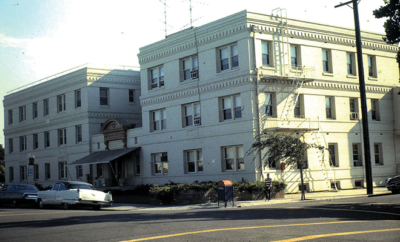
Prior to Lodi Memorial, Lodi had only two hospitals, both private. The first, Buchanan Hospital, was built in 1910 as the Buchanan Sanitarium after its founder, Robert Buchanan, set up practice in Lodi in 1909. The second, Mason Hospital, was completed well after the death of the man who started it, Dr. Wilton Marcellus Mason.
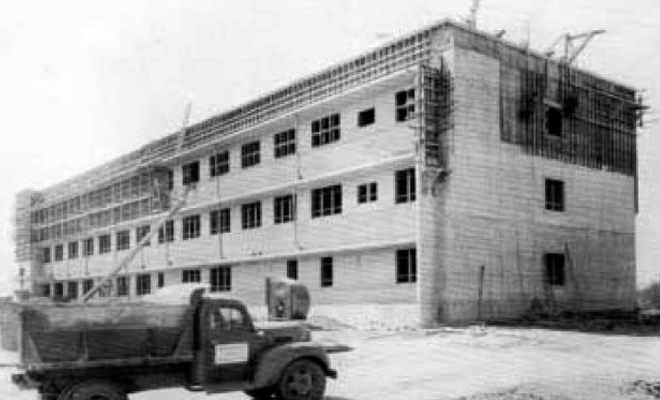
The idea that eventually became Lodi Memorial began in 1945, when public accountant Vincent Webb investigated the need for a hospital in Lodi at the request of Lodi Chapter 59 head Oscar Ditmanson. Webb found only 60 beds and 11 doctors spread between Mason and Buchanan. The two met with other Lodi figures to discuss building a hospital for Lodi and decided to form a nonprofit organization funded by public subscription, writing articles of incorporation for the Lodi Memorial Hospital Association on Pearl Harbor Day, December 7, 1945, a date, alongside the “Memorial” part of the name, chosen to honor the 4,000 men and women from the greater Lodi area who served in the armed forces during World War II. Between 1945 and 1950, they successfully raised enough money to start building the hospital in 1950 and opened it on March 30, 1952, to a crowd of more than 8,000 visitors at the ribbon-cutting ceremony. Five years later, it received its first full accreditation.
The hospital grew in size over the years to serve the town’s increasing needs. Overcrowding was a problem, and the facility was forced to turn patients away in 1963, despite having just completed two new wings. In 1965, plans for additions were initiated, and new construction was completed in 1968. The 1980s brought further expansions, which were funded by the newly established Lodi Memorial Hospital Foundation. The third and largest expansion of the hospital during the 20th century took place in 1982, when 47,000 square feet of space were added at a cost of $8.5 million. The 1990s saw further expansion, with the purchase of the Doctors Hospital of Lodi to use as a West campus, the establishment of an adult daycare service, a West Fitness Center, two new outpatient units and a growing presence in Galt.
The 21st century brought further evolution. First, a south wing was built in 2009, and then Lodi Memorial renamed itself Lodi Health in 2013. In 2015, Lodi Memorial joined the national conglomerate Adventist Health, a partnership that brought capital necessary to grow the cardiology and oncology departments and improve the capacity and reaction times of the emergency department. When the COVID-19 pandemic hit San Joaquin County in 2020, Adventist Health worked tirelessly to ensure our citizens got the essential care, testing, vaccinations and treatment they needed.
Adventist Health Lodi Memorial, alongside Diana J. White Cancer Institute at Adventist Health Sonora, were the first two Adventist Health facilities to achieve APEx, or Accreditation Program for Excellence, accreditation from ASTRO, the American Society for Radiation Oncology, America’s fastest-growing radiation oncology accreditation program, for its radiation oncology team. This honor to Lodi, and the ways both Adventist Health and Lodi Memorial have met the needs of not only our residents but San Joaquin County overall, were all made possible by the need two veterans saw in 1945 for Lodi to have a public hospital and the support of Lodi’s people to ensure it happened.