


From First Issue to School Tradition: How Stagg High Built a Student Magazine Movement
Story and Photos by Shawnna Weber
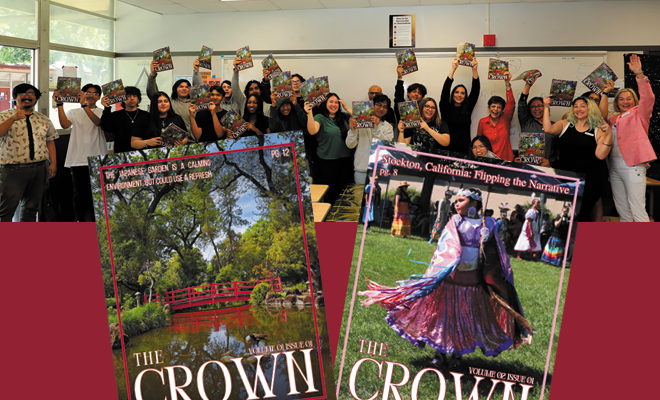
In April 2025, Stagg High School in Stockton published something it had never created before—a student print magazine titled The Crown.
What began as a single, sponsored project quickly became something much more.
Within weeks of releasing the first issue, the response from students, teachers and the broader community was so enthusiastic that the school moved immediately to produce a second issue, this time dedicated to graduating seniors. What started as an experiment had already begun to take root.
Today, just over a year later, Stagg High has published four issues in the 2025–26 school year and is well on its way to establishing a lasting tradition. What’s happening at Stagg High is not unique. This model is proving to be both practical and replicable for schools across San Joaquin County and beyond. Franklin High in Stockton, for example, recently published its first-ever magazine, The Hive, following a very similar approach.
A Community Effort from the Start
The initial spark came from a collaboration that brought together education, community organizations and local business.
Support from the Junior League of San Joaquin County and sponsorship from a local business, Edgewood Business Solutions, Inc., made it possible for Stagg students to bring their first magazine to life. That early backing removed what is often the biggest barrier, cost, and let students focus on creating something meaningful.
“At the Junior League of San Joaquin County, or JLSJC, our mission is to advance women’s leadership for meaningful community impact through volunteer action, collaboration and training,” said Margarita Reyes, magazine program chair and a past president of JLSJC. Formerly known as Junior Aid of Stockton, JLSJC is on its 98th year of service to San Joaquin County and looks forward to continuing its legacy of service as it heads into its centennial year in 2027. “We are thrilled to have Stagg High School as our inaugural funding recipient. It was a joy to see how connecting resources, providing initial funding and support empowered and amplified student voices through the magazine program. We look forward to expanding this opportunity to other high schools seeking to launch their own student-led magazines and create platforms for student expression and storytelling.”
What made this especially feasible was a new model for student publishing. Using aPrintis, the school was able to produce its first issue, a 16-page, full-color, glossy, premium-quality magazine with 100 copies, for approximately $220. At a price point once considered out of reach for this level of quality, the project became accessible from the very beginning.
“As a strong supporter of youth education and student voice, I’m always looking for meaningful ways to support our local schools,” said Shawnna Weber, CEO of Edgewood Business Solutions, Inc., and a former president of the Junior League of San Joaquin County. “When I learned about aPrintis’s publishing model and the price point, it was a no-brainer to introduce them to JLSJC. Seeing Stagg High students bring that vision to life has been both rewarding and inspiring.”
Starting Small, Thinking Big
Rather than aiming for scale immediately, the school intentionally started small.
That first issue, just 100 copies, was enough to build excitement, showcase student work and demonstrate what was possible. Because the up-front cost was modest, the barrier to getting started was low, and the need for large-scale fundraising was reduced.
This “start small” approach proved critical. It allowed the program to focus on quality, participation and momentum rather than logistics or budget constraints.
Students Take Ownership
What made the project special wasn’t just the final product—it was the process.
Students collaborated on writing, photography, design and editing. They worked to deadlines, made creative decisions, and saw their ideas come together in a tangible, professional-quality publication. For many, it was their first experience creating something for a real audience, not just for a grade, but for classmates, teachers, families and the wider community.
That shift changed everything. “I’m proud of Stagg students for stepping up, embracing the opportunity, and truly owning it,” said journalism advisor Chris Valdez. “It’s been incredible to see the program grow, with more student involvement, greater initiative and improved quality with every issue.”
When students know their work will be read by people they know, the level of care, creativity and accountability rises. The magazine became more than a project; it became something they were proud to contribute to and share.
“Creating our first school magazine was an unparalleled leadership and creative experience for me and our entire team,” said Savannah Advincula, managing editor of The Crown. “It’s something we’ll carry with us and showcase as an early achievement in whatever paths we pursue.”
Building a Sustainable Model
After the success of the first two issues, Stagg High set an ambitious goal. The school planned for four issues during the 2025–26 school year and successfully delivered all four.
As the program grew, so did the funding model. While the initial issues were fully sponsored, the school began incorporating community fundraising. Using aPrintis’s zero-cost fundraising tools, the school raised more than half of the printing costs through sponsorships and community support.
Because the overall cost per issue remained low, fundraising became more achievable and more inclusive, allowing the broader community to feel invested in the publication’s success.
More Than a Publication
The impact of the magazine has extended well beyond the classroom.
Each issue has become something students and staff look forward to, something that captures moments, celebrates achievements and reflects the spirit of the school. Copies circulate through classrooms and homes and are shared with families and visitors.
In a very real sense, the magazine has become an ambassador for Stagg High, representing its students, its culture and its community in a tangible and lasting way.
The quality of the publication plays an important role. When a magazine looks polished and professional, it invites readership. It signals care. It draws people in and keeps them engaged. “School magazine creation has been a whole new experience for us,” said Savannah. “It’s a way to connect with everyone, collaborate and create something that feels timeless.”
A Platform for Student Voice
For many students, the magazine became a platform to tell stories that matter. “This was personal for me,” said Ariella, news lead of The Crown. “I care deeply about how Stockton is portrayed, so writing about the city’s cultural richness and diversity gave me a meaningful outlet.”
“It was great to have a place to showcase our band and highlight Spirit Week and other events,” added Avian, another editor. “It’s something everyone in the school can relate to and relive.”
A Model Other Schools Can Follow
What makes Stagg High’s experience especially compelling is how achievable it is. The program did not require a long-established journalism department or a large budget. It started with:
• A small group of motivated students
• One or two staff members guiding the effort
• A modest initial print run
• Early community support
From there, it grew through student ownership, community engagement and a model made practical by affordable, high-quality publishing.
Today, the school is not just producing magazines; it is building a tradition. “Over the years, we’ve seen that even in a digital-first, AI-driven world, school magazine publishing not only builds powerful, transferable skills for students but also brings their communities together in unique ways,” said Vivek Garg, CEO of aPrintis. “Stagg High’s journey is a great example of what’s possible and what every K-12 school can achieve.”
Looking Ahead
Stagg High plans to continue publishing in the years ahead, with even greater community involvement and student participation. What began as a one-time project has become part of the school’s identity, an ongoing opportunity for students to create, collaborate and contribute to something larger than themselves.
For the Stockton community, it stands as a powerful example of what can happen when barriers to high-quality publishing are removed, when affordability, community support and student creativity come together.
When affordability, community support and student creativity align, even a small beginning can grow into a lasting part of a school’s identity.