


 Kevin Richtik, Caroline Photography
The Case for a Slightly Boring Bedroom
After 18 years of bedroom projects, I can tell you the most restful rooms in a house are rarely the most interesting ones.
Ask a homeowner where they want to start, and almost nobody says the bedroom. They say the kitchen. The great room. The powder room that has embarrassed them since 2011. The bedroom lands at the bottom of the list, right below the garage, because no one sees it. It gets the leftover furniture, the leftover budget and a bedspread that was purchased under fluorescent lighting during a moment of weakness.
Then life happens. A hard diagnosis. A long stretch of caregiving. A parent who needs help. A season where the day takes everything you have and the only thing you want at eight o’clock is a room that does not ask anything of you. That is when people find out what their bedroom is actually made of.
Rest Is Not a Decorating Style
A restful bedroom is not a color palette. It is a series of decisions that keep the room from arguing with you. There is a whole category of bedroom advice built around the word calm. Soft neutrals. A few candles. Maybe a eucalyptus branch in a vase.
That is not design. That is a photo shoot. Rest comes from a room that works at two in the morning, not one that photographs well at two in the afternoon. Can you find the light switch without waking the person next to you? Is there somewhere to set down a water glass, a phone, a book and whatever else the week has handed you? Can you get to the bathroom without navigating a furniture obstacle course? A room can be beautiful and still be exhausting. I have walked into plenty of them.
Start With the Bed, and Be Honest About the Wall
Almost every bedroom problem I see traces back to bed placement.
The bed wants a solid wall, a clear view of the door, and enough room on both sides for a person to walk and a nightstand to live. That sounds obvious until you meet the primary bedroom with three doors, two windows, a fireplace and one usable wall that happens to be four inches too short for a king.
This is where an honest conversation has to happen. Sometimes the answer is a queen instead of a king, and the room gains three feet of breathing space. Sometimes the answer is moving a door. In one Lodi project we solved a tight primary suite with a barn door, which bought back the swing space a hinged door was stealing and gave the room a piece of architecture it did not have before.
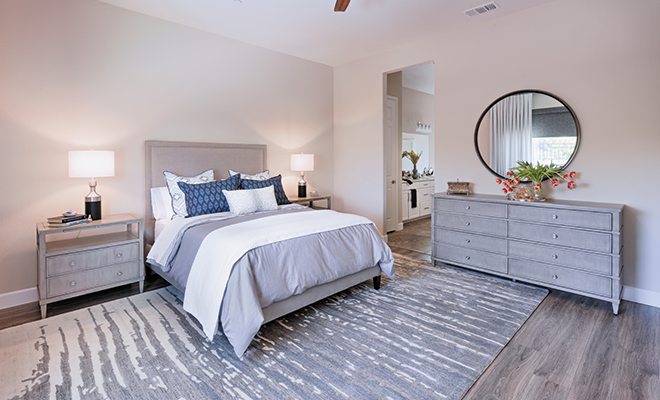
Two nightstands, by the way, even if only one person sleeps there. Symmetry settles a room down. It also means the second side is ready when someone needs to sit with you, which is not something most people think about until they need it.
Lighting Is the Whole Argument
One overhead fixture and a wall switch is not a lighting plan. It is a habit.
If I could change one thing in every bedroom in America, it would be the light. A single fixture in the middle of the ceiling, operated by one switch, is a hospital corridor with better bedding. You need layers, and in a bedroom that means at least three: Ambient light for making the bed and finding a sweater. Task light at each side of the bed, on its own switch, bright enough to actually read by and positioned so the shade sits near shoulder height when you are sitting up. Low light for the middle of the night, which can be as simple as a lamp on a dimmer or a small fixture near the floor that lets you get to the bathroom without a full wake-up call.
Put the ceiling fixture on a dimmer. Put the bedside lamps on switches you can reach lying down. If someone in the house is recovering from anything, this stops being a nicety and becomes the difference between a decent night and a rough one.
Then handle the windows twice. Woven wood shades filter daylight and give the room texture. Lined drapery behind them handles the 6:00 a.m. sun and the neighbor’s motion light. In a Stockton guest room we ran slate blue drapery over woven wood shades, and it does both jobs without the room looking like a home theater.
Give the Clutter Somewhere to Land
Here is the part nobody puts on a mood board.
Nightstands need drawers. Real ones. A bedside table with a pretty open shelf is fine until the shelf is holding reading glasses, a charger, hand cream, a remote, three books and a small pharmacy. Then it is just a pile with legs.
Closed storage at the bedside keeps the room quiet. It also protects a person’s privacy, which matters more than people realize. Nobody wants their nightstand narrating their health to every guest who walks by.
The same logic applies to the rest of the room. A bench at the foot of the bed with storage inside. A dresser with a drawer that is not spoken for. A closet system that actually reflects what you own now, not what you owned in 2009.
Quiet Is a Design Decision
Sound is half of rest, and hard surfaces are the enemy.
A rug that runs under the bed and out past the nightstands. Drapery, which absorbs far more than people expect. An upholstered headboard, which softens the wall behind you and keeps the room from echoing. A solid core door instead of the hollow one the builder installed.
None of this shows up in a photograph. All of it shows up at three in the morning.
The Chair Is Not for Laundry
Most bedrooms have a chair. Most bedroom chairs are wearing a sweater from Tuesday. I have worked on bedrooms where that chair turned out to be the most important piece of furniture in the house.
Give the chair a reason to exist. A real seat with arms, a small table beside it, a lamp behind it. Suddenly it is somewhere to put your shoes on, somewhere to sit and drink coffee, somewhere for your daughter to sit and talk to you on a day when you would rather not get up.
What Holds Up in a Hard Season
This issue is about cancer awareness, and I am not going to pretend a well-designed bedroom has anything to do with medicine. It does not.
But I have designed rooms for clients in the middle of treatment, for clients recovering from surgery and for clients who were caring for a husband or a mother and needed the house to stop being one more thing to manage. What I learned is that the rooms that hold up during a hard season are the ordinary ones done well.
Good light you can control from bed. A place to put things down. A floor you can cross barefoot in the dark. A window covering that lets you sleep past sunrise. A chair for the person who came to sit with you. Nothing about that is dramatic. All of it matters when the rest of life gets loud.
That is also why I am careful with trend-driven bedrooms. The room you rest in should not have opinions. It should not require maintenance, a decorative pillow ceremony every morning, or four steps to turn off a light. It should be well made, comfortable, quiet and slightly boring in the best possible way.
Start Small, Start Anyway
You do not need a full remodel to fix most of this. New lamps with the switch in the right place. A second nightstand. A rug two sizes bigger than the one you have. Drapery added over existing shades. A door that closes properly. That is a weekend and a modest budget, and it changes how the room feels at night.
The bigger point is this. Every other room in your house is built to serve other people. Guests, dinners, homework, holidays. The bedroom is the one room that exists entirely for you. It deserves better than the leftovers.

Kathleen Jennison is the founder and principal designer of KTJ Design Co., a full-service residential interior design firm in Stockton. With a background in accounting and a sharp eye for proportion, she designs homes for clients navigating a new chapter, pairing creative direction with the documentation and follow-through that gets a project finished. Her work is avant-garde yet livable and always built around how people actually live.
404 N. Harrison | Stockton, CA 95203 209.915.0442 | kathleen@kathleenjennison.com