


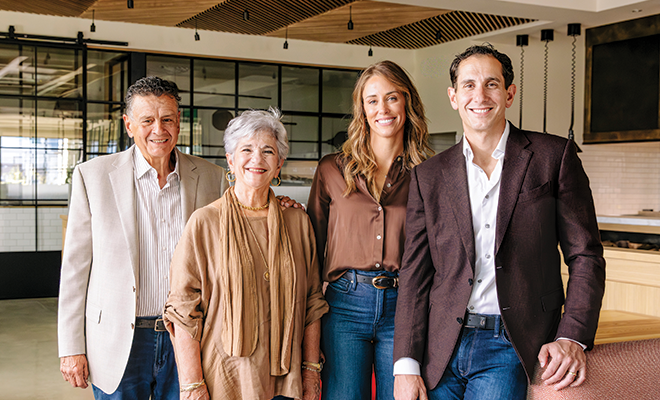
Pete Murdaca: “We’re authentic to our family.”
Photos by Alanna Hale
For much of human history, hospitality has been regarded as a sacred way of life. Ancient cultures from around the world believed that every stranger could be a god in disguise, and to turn away a guest was to risk incurring wrath from heaven. Although modern American culture tends to approach hospitality as an industry, there are some places that gently defy the breakneck pace of the business, instead leaning into creating an experience that treats each guest like a god in disguise. Pietro’s Trattoria is one such haven of hospitality.
In the early 1950s, Pietro Murdaca left the mountains of Calabria, Italy, and moved to the rolling hills of Vacaville, California, with his wife. Both of them were from large families; he had eight siblings, she had seven, and they opened the original Pietro’s in 1956 with the dream of sharing their experience of familial hospitality through their restaurant. On the foundation of the core values of quality food, customer service and respect for employees, Pietro’s grew into a notable success.
The Murdaca Family
Pete Murdaca, Pietro’s grandson, grew up in the warm embrace of his family’s restaurants. His father, Jim Murdaca, had opened the Pietro’s location in Lodi in 1985, and his aunt and uncle owned restaurants in Redding and Vacaville, including the first Pietro’s. “It’s what we did,” he said. “It was always a comfortable place for me.” Although the restaurant was never the center of his family’s life since he was intensely involved in competitive sports as a youth, Pietro’s was nevertheless an ever-present part of his childhood. He reminisced about doing dishes in the back when he was ten: “I thought it was fun,” he said. He cycled through different jobs in the restaurant as he grew, specifically enjoying working in the front where he could interact with both staff and customers. “I was a busser, host; I did everything,” he smiled.
Though his roots were in the restaurant business, Pete always thought he was going to branch out on his own. Both of his parents were small business owners, and many of their friends were as well, and he too had an entrepreneurial spirit, enjoying the fast pace and variety. He attended University of Nevada and then transferred to Delta College to play football before finishing his degree at Sacramento State University. After graduation, he returned to Pietro’s to manage the front for a while, then moved to San Francisco, working adjacent to the industry selling beer and wine. But all the while he kept finding himself drawn back to his roots, to the point that his then-girlfriend, now-wife, Tyler, encouraged him to speak with his parents about joining the family business.
The Italian Sensibility
And so, after much thought and preparation, Pete found himself broaching the topic of joining the family business with his parents. After a lot of discussion, they agreed, on one condition. “The only way he’d let me do it is if I went to Italy and learned how to cook,” Pete said with a laugh. “I had to know every aspect of the business.” He had already looked into several different culinary programs, and he applied and was accepted to a “stage,” pronounced “stah-je,” an internship that offered him hands-on experience in the mountains of Calabria. He knew rudimentary Italian from his lessons in high school, and he had also studied abroad in Rome for six months during his college tenure. It was then, he said, “I really fell in love with Italy and the culture and the people. I always wanted to go back.” He was excited to immerse himself in the Italian way of living. There, in a small room above a hotel that overlooked the mountains his grandparents had called home, Pete learned what he called “the Italian sensibility.”
The experience was rewarding but also grueling: Pete described it as “16-hour days getting yelled at in a different language.” Despite its difficulty, the internship was also life-changing on many levels. He connected with his cousins in Calabria and was touched by how warmly they welcomed him; they even drove two hours to the airport to say goodbye the day he returned to the United States. He was grateful for the hospitality everyone showed him, from his own extended family to the family that hosted him and the chefs he worked with. “They took care of me,” he said. He worked at restaurants in Calabria, Parma and Rome, and not only did they teach him the basic skills every chef needed to know, but he also learned “how they source product, the care they take in things, the quality and the importance of quality, the pride they take in what they do,” he said. “That’s what I took away from being there. I learned how to run a business in the United States, but I learned how to cook and care for things in Italy.”
Other parts of his life slid into focus through the lens of his culinary pilgrimage. Many of the things he admired about his parents, such as their deeply rooted community connections, came from this Italian sensibility. “That’s how my dad grew up, and my grandparents too,” he said. His mother’s selflessness and his father’s kindness distinguished them not just as business owners, but as friends and community members. While he respected their sharp business sense and their tireless work ethic, it was this lifelong embrace of hospitality that truly set them and their restaurant apart.
Equipped with both the knowledge of practical cooking skills and the immersive experience of the Italian way of life, Pete returned home and assumed the role of head chef at Pietro’s. He flourished in the fast-paced creative environment, continuing to lean into the Old World Italian aesthetic with a focus on simplicity and letting the fresh and local ingredients speak for themselves in the dishes he created. In 2021, Jim and Annette Murdaca retired and sold the business to Pete and Tyler, making Pietro’s a third-generation restaurant. Tyler continues to actively support the restaurant in administrative and creative capacities, and though Pete now primarily focuses on his numerous leadership responsibilities, he still enjoys creative control over the menu and can often be found in the kitchen.
Breaking Ground, Branching Out: A New Location
As Pietro’s continued to grow and establish itself as a cornerstone of the Central Valley culinary scene, they also began to stretch the limits of their building’s capacity. They had been at the Kettleman Lane location since Jim Murdaca opened it in 1985, and with its flourishing patio gardens and intimate interior, the building itself was almost as beloved as their menu. However, parking had become a nightmare, even with valet options. Wait times had grown longer, crowds bigger, and it slowly became evident that the restaurant would need a larger location to keep up with their increased demand and popularity. Over the course of a few years, they thoughtfully began making plans to build and relocate to someplace larger.
Pietro’s new location was designed with as much meticulous care as their menu. It stands in Lodi Reynolds Ranch, a beautiful two-story building with a stately stone façade and familiar garden-lined pathways. Arcanum Architects, which had already worked with the restaurant for their previous remodel in 2017, returned for this project along with de la Cruz Interior Design. The result is a masterpiece. From the bar, a sleek and cool-toned alcove off the entrance, to the interior seating with its quieter corners that overlook a mural of the Italian countryside or a glimpse of the bustling kitchen, Pietro’s new building is a work of art, spacious yet still intimate, elegant and inviting.
The courtyard in particular was a labor of love. Knowing how many people adored their former location’s iconic patio, Pete and landscape architect Jeff Gamboni spent many hours making sure the new courtyard paid it adequate homage. Citrus and olive trees line the courtyard, their branches green with new growth, and the music from overhead speakers is mingled with the gentle sound of the fountain. The louvered roof offers protection from the harsher elements while also letting guests enjoy the soft summer breeze or glimpse the clear winter stars. “I think we somehow made it better. I don’t know how we did it, but we did,” said Pete. “That’s my proudest moment of this place, translating the courtyard from the old location to the new.”
The new location allows Pietro’s to expand their horizons and better meet the needs of their existing customers. “We’ve brought everything in house now,” Pete said proudly. “Seeing that evolve has been really fun. Seeing the quality become so much better, it’s been something I’ve really enjoyed.” Fresh, handmade pasta has always been a staple of Pietro’s farm-to-fork menu, and now their new location offers a pasta lab, one of the first in this part of the state. They also have a marketplace where customers can linger as they wait for their tables or takeout, well-stocked with a variety of goods, from hats embroidered with the restaurant’s name to dried oregano imported from Calabria, just like Pete’s grandmother grew in her gardens.
Farm to Fork to Future
Pietro’s menu remains simple and steadfast in the face of the recent changes, still committed to seasonal freshness, intentional ingredient sourcing and unique spins on traditional dishes. They’ve reintroduced some old favorites, such as veal parmigiana, now garnished with fried basil and fior di latte. “We were able to source really quality product,” Pete said, excited to be returning to a classic dish from the restaurant’s past in a new era. The handmade pasta dishes often steal the spotlight, and rightly so. “The pasta section is always fun because it’s alive,” Pete said. “There’s a lot of technique that goes into finishing a pasta correctly, which I love.”
Drink options are a fun complement to the menu, with local and European wines alongside the restaurant’s unique spins on classic cocktails. The popular Smoking Gun cocktail is an elevated take on an Old Fashioned, with whiskey and brown sugar, infused with smoke tableside in a glass cloche and garnished with an orange peel. For those looking for non-alcoholic options, they also make mocktails such as the Michelangelo, a sparkling citrus-forward drink made with zero-proof tequila.
Everything the restaurant does is scaffolded by its core values of quality food, customer service and respect for employees. “We take our core values seriously,” Pete said, and it’s much more than just a restaurant tagline; the truth of his words is apparent in the quiet details, from the care put into each dish on the menu to the servers who remember you from your last visit. “It’s a family business,” said Pete. “And we’re authentic to our family.” As it was with his grandfather and namesake, family is the linchpin of Pete’s inspiration and motivation. As they continue to settle into the new location, Pete looks forward to their future plans of eventually transforming their former location into a restaurant called Jimmy’s that honors his father. “He was the one who laid the foundations,” Pete said. “I want to name it after him and honor him and all that he brought to Lodi.”
Pietro’s may have changed in many ways since the original eatery first opened its doors in Vacaville, but its essence remains the same, built upon the spirit of hospitality and hard work that was cultivated by Pete’s grandparents in the mountains of Calabria. “I’m really grateful for the opportunities given to us by my immigrant parents and grandparents,” Pete said. “I’ve tried to keep the immigrant mentality of making it better for the next generation. I want to make them proud and continue what they started.” By sharing their family’s legacy through their restaurant, the Murdaca family has made a beautiful and indelible mark on the local community and beyond, and Pete shoulders that legacy well as he ushers it forward into the next generation. Pietro’s has stood as a cornerstone of the Central Valley’s culinary scene for more than 40 years, and it will stand for more than 40 more, firmly rooted in Italian sensibility of prioritizing care over convenience and treating meals and guests as something sacred.