


Tiny but Mighty…The Female Workforce Turning Spring Blossoms Into Cherries
By James Chinchiolo
Every spring in the San Joaquin Valley, there is a small window of time that determines whether or not a fruit crop will be successful. For cherry farmers like me, that window is bloom.
When our cherry trees open their blossoms, every flower represents the potential for a cherry. However, that potential only becomes fruit if pollen is moved from one blossom to another. That job belongs to bees.
Most people see bees as part of nature. Farmers see them as essential partners in food production.
Not all cherry varieties pollinate the same way. Our Coral Champagne cherries depend on pollen from other varieties such as Brooks, Tulare and Bing, while our Lapins cherries are self-fertile and grow in their own section of the orchard. In both cases, it is the female worker bees that move pollen from blossom to blossom. That simple movement is what allows fertilization to happen and cherries to begin forming.
Without bees doing that work during bloom, a cherry orchard would produce little to no crop.
At our Lodi Blooms cherry orchard in San Joaquin County, the sound of bloom is the hum of bees moving through the trees. Each hive contains tens of thousands of bees, and during peak bloom they work the orchard from morning until evening. A strong bee flight during bloom is one of the best signs a farmer can see.
At the center of every hive there is a single queen bee. She does not leave the hive to work the blossoms. Her role is to lay eggs and keep the colony strong and growing. The bees flying through the orchard are her daughters, the female worker bees that do the pollination work from sunrise to sunset. Male bees, called drones, play a different role inside the hive and do not take part in pollinating the orchard. A healthy queen means a strong hive, and strong hives mean more worker bees moving pollen through the orchard during bloom.
While cherries are a good example, this relationship between bees and agriculture extends across the entire San Joaquin Valley. Many of the crops grown here depend on pollination. Almonds, cherries, plums, apples, blueberries and numerous seed crops all rely heavily on honeybees to produce a harvest. Even crops that are not directly dependent on bees benefit from the broader ecosystem that healthy pollinator populations support.
In practical terms, bees are a critical piece of California agriculture’s production system, just like irrigation water, soil fertility and sunshine. That is why farmers and beekeepers work closely together.
At Lodi Blooms, we partner with Becker Bees, a fourth-generation beekeeping family here in the San Joaquin Valley. Our family has farmed in this region for four generations as well, and the relationship between growers and beekeepers is built on trust and experience that develops over many seasons.
The bees arrive just ahead of bloom and are placed carefully throughout the orchard. From that point forward, orchard management has to consider the health and activity of the bees. Spray timing, product selection and orchard practices all have to respect the pollinators that are helping produce the crop.
When the bees are healthy and active, pollination is strong and fruit set improves. In many ways, the beekeeper and the farmer are working toward the same goal during bloom.
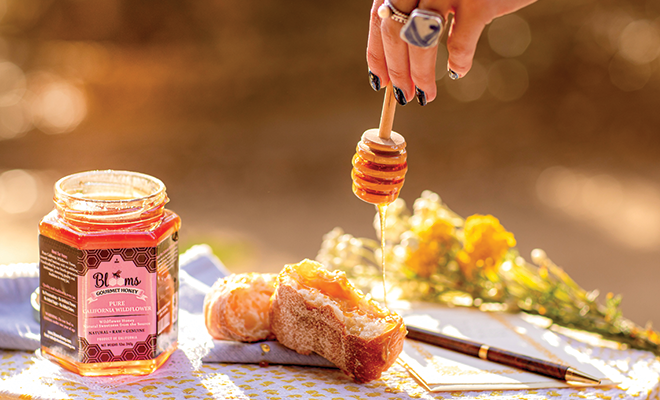
That partnership continues beyond pollination. Becker Bees also produces the honey that we bottle as Blooms Gourmet Honey. The nectar collected by their bees across the valley becomes honey that reflects the agricultural landscape those bees work in each spring.
For our family farm, bloom is the starting point of the entire cherry season. What happens during those few weeks determines what will be hanging on the trees when early summer arrives.
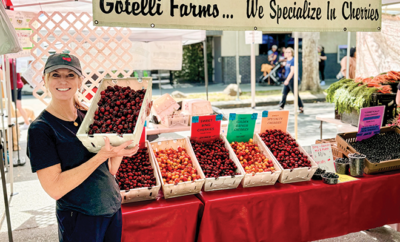
Then, suddenly, it happens. By early to mid-May into early June, those blossoms the bees worked so hard become the deep red cherries our customers wait all year for. That is when Lodi Blooms opens for cherry picking, and families can walk the same rows where the bees were buzzing weeks earlier and pick cherries straight from the trees, enjoying the sweet results of the pollination that started the whole season. It is an experience that connects our customers directly to the process of growing food.
For farmers, the lesson is simple. Healthy pollinators mean healthy orchards. The work bees do during bloom may last only a few weeks each spring, but the results of that work carry through the entire season.
Every cherry begins with a blossom, and every blossom depends on the quiet work of bees.