


 Photos courtesy of the San Joaquin County Historical Museum
A Century on the Water: Florence M II and the Legend of Kerosene Kate
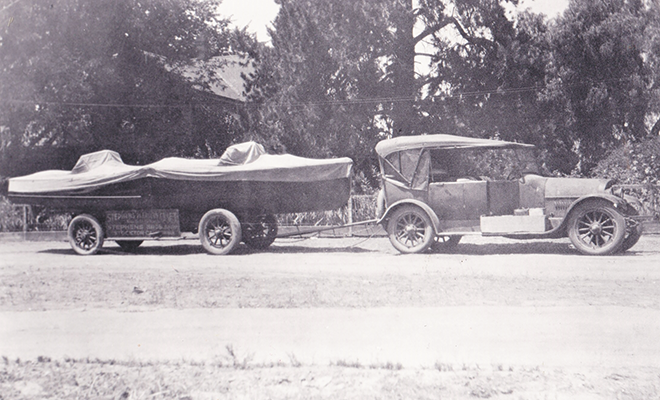
Long before the age of freeways and powerboats, getting a mahogany runabout from San Joaquin County to Lake Tahoe was no small feat. For the Morse-Bewley family of Lodi, it meant loading their Florence M II boat onto a trailer, hitching it to a 1917 REO touring car and setting out for two grueling days of unpaved mountain roads. The car that made that journey possible became as celebrated as the boat itself: a kerosene-burning REO Speed Wagon known to all as “Kerosene Kate.”
The story begins in the Delta. In the early 1900s, Stockton brothers Thod and Roy Stephens had built a thriving boat works on the banks of the Stockton Channel, supplying fast wooden runabouts — called “spud boats” — to agricultural brokers who needed to race between Delta farms to secure the best produce prices. An extra mile per hour could mean winning or losing a deal. By 1925, the Stephens Brothers had parlayed their hard-earned expertise into building sleek 26-foot teak-hulled pleasure runabouts that would become some of the most coveted water craft in California.
E.E. Morse a Lodi farmer who had long brought his family camping through the Sierras, was among the first to want one. The family already owned a summer residence on the west shore of Tahoe and had kept an earlier Stephens launch, the original Florence M, since 1915. In 1925 they purchased the new Stephens 26 and named her Florence M II in honor of Florence, E.E.’s wife. With two cockpits, a teak hull and a powerful Scripps engine, the boat was built for both leisure and speed.
Getting Florence M II to the lake was the adventure. No paved highway connected Lodi to Tahoe, and no proper launching facilities existed on the steep eastern and western shores. The family was forced to push the trailered boat across a sandy beach near present-day Camp Richardson on the southern shore, then navigate north to their home in Homewood. The car doing the heavy pulling was famous in its own right.
The REO Model M — a large, powerful six-cylinder touring car — had earned its nickname through a series of daring mountain crossings by J.C. Skinner, an inventive Stockton automobile dealer. Frustrated by the difficulty of finding gasoline in remote Sierra passes, Skinner devised a vaporizer system that allowed the engine to run on kerosene, a cheaper and far more widely available fuel. In the fall of 1917, equipped with his converter and a set of wooden spools bolted to the rear wheels to winch the car free from snowdrifts, Skinner circled the Sierra Nevada — crossing both Sonora Pass at 9,624 feet and Ebbetts Pass — covering 358 miles in just over 28 hours. Local newspapers were enchanted, and the car’s nickname was born. A gala dinner in Stockton that December included a poem printed on the menu: “Kerosene Kate is never late / Always in a hurry, with never a flurry.”
That same car — or one very like it — would spend decades in the service of the Morse-Bewley family, hauling Florence M II up the mountain every summer and back down to Lodi every fall, where the boat spent winters in the barn.
At Tahoe, the boat found its true calling in the racing circuit of the Tahoe Powerboat Club. E.E.’s daughter Evelyn — known as Eve — was, by all accounts, fearless. She stripped the seats from the boat to shave weight, recruited her young nieces as mandatory crew (racing rules required two people aboard), and proceeded to win trophy after trophy in the annual “Bang and Go Back” races. To stay competitive into the 1940s, the family swapped out the original six-cylinder Scripps engine for a Chrysler Crown with eight cylinders so large it consumed the entire engine compartment, forcing the fuel tank to be relocated to the stern. The modifications worked. Florence M II kept winning.
Eventually, as the older generation stepped back, the Bewley children took over — learning to waterski behind a boat powerful enough, family lore holds, to tow four people at once. Florence M II remained at Tahoe for forty continuous years, wintering in the Delta when the family eventually brought her back down the mountain.
In time, the family donated both Florence M II and “Kerosene Kate” to the Tahoe Maritime Museum in Homewood, just a block from their lakeside home. When the Tahoe Maritime Museum closed. The Bewley family’s preference was ultimately that the artifacts come to the San Joaquin County Historical Museum — closer to the Lodi farm, the Delta waterways, and the Stockton boatyard where the whole story began. The artifacts are an incredible chapter of local history and remain on permanent display at the San Joaquin County Historical Museum.