


The Jewish Festival of Hanukkah Explained by Stockton Rabbi
In the midwinter darkness, a candle burns. Joined by another, then another, the flames of the menorah dance across continents and oceans, each light a symbol that unites a people through their shared faith. The Jewish festival of Hanukkah, also spelled Chanukah to reflect the Hebrew pronunciation, commemorates the rededication of the Temple in the second century BCE during the Maccabean Revolt. For the Jewish people, the Maccabean Revolt is a very significant event: “It’s often regarded as one of the first battles fought in the name of religious freedom,” said Rabbi Jason Gwasdoff, who serves as the rabbi of Temple Israel in Stockton, one of the oldest Jewish congregations in the state of California.
The historical context of the festival of Hanukkah begins when Antiochus IV, Greek king of the Seleucid Empire, outlawed the practice of Judaism. “The daily practice of Jewish life–the study of Torah, observing Shabbat, circumcision–those things became officially outlawed,” Rabbi Gwasdoff explained. “That’s what stirred the traditional masses to stage this revolt.” Led by the priest Mattathias along with his five sons, the Jewish people fought back against Antiochus IV and his draconian restrictions.
Despite the strength of the Seleucid Empire and being greatly outnumbered, they managed to drive out Antiochus’s forces and reclaim the Temple. “The victory alone was a miracle, that the Maccabees could win this battle against an army far superior in numbers and strength,” said Rabbi Gwasdoff as he recounted the story, his tone gentled by repetition and reverence.
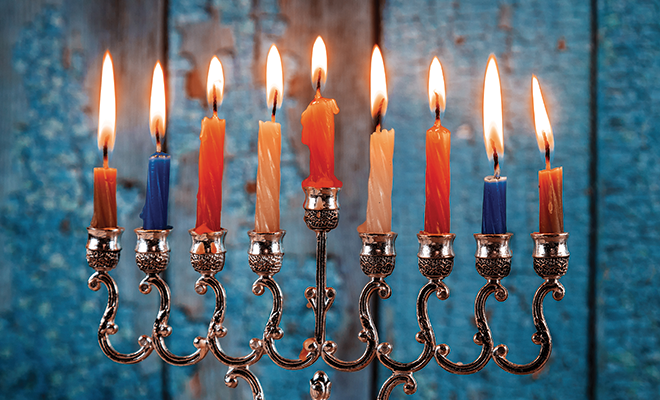
Though the Jewish people had successfully reclaimed the Temple, it needed to be cleansed. Antiochus IV and his forces had set up their own idols and slaughtered pigs upon the altar to intentionally defile it. They cleansed the Temple and held a celebration for eight days to rededicate it: and thus, the festival of Hanukkah (hanukkah means “rededication”) became an established part of Jewish faith and life. There are a few different explanations as to why the festival spans eight days, but as Rabbi Gwasdoff said, “One interpretation we get from the Talmud, a very important book of Jewish law and lore, is the story of the Miracle of the Light.” When the people went to relight the lights of the Temple, there was only enough oil prepared for one day, but miraculously, the cruse of oil lasted eight nights, the exact amount of time it took to prepare new oil. From this story comes the tradition of lighting the eight candles of the Hanukkah menorah, adding one candle each day of Hanukkah (from one to eight), in remembrance of the Miracle of the Light. This is also why foods fried in oil, such as latkes (potato pancakes) and sufganiyot (jelly donuts) are traditional Hanukkah fare; they too are a remembrance of this miracle.
In 2025, Hanukkah spans from December 14 to 22, and Temple Israel will be hosting their celebration on the first night, Sunday, December 14. This year, festivals at Temple Israel have been especially exciting as the temple celebrates its 175th anniversary, and Hanukkah is no exception. “All our choirs will be singing, and our dance group will be dancing, and we will touch upon that theme of the longevity of our congregation here in Stockton,” said Rabbi Gwasdoff. “It’s really quite a wonderful thing to celebrate.” And, as in all holidays and festivals, “A component of the celebration is tzedakah, which means ‘righteous giving;’ by giving to others, we are increasing the joy of the holiday and giving it its meaning,” he said, touching on how the Hanukkah celebration affects not just his congregation, but the local community as a whole.
Every person, regardless of ethnicity or religion, can look to the celebration of Hanukkah as an example of joyous resilience and hope. It can be easy to forget what a privilege religious freedom is, but festivals such as Hanukkah, rooted in deep faith and cultural traditions, are a poignant reminder of those who have sacrificed much and fought hard for those privileges. The festival of Hanukkah is, as Rabbi Gwasdoff said, a story of “not just passive hope, but an active hope.”
As the candles burn, as food is shared, as the children sing and dance, may we all be reminded of the beauty of resilience and the power of hope.