
What If? Roadside Hazards and Safety
It finally happened to me. After many years of driving back roads and interstate highways alike, a tire hit some unknown road hazard.
pop! Within 30 seconds, the dreaded thwap-thwap-thwap sound of flapping rubber began and thankfully there were no cars in the three right lanes of a five-lane interstate highway. I consider that something like a miracle. I decelerated by taking my foot off the accelerator, gently braked and navigated to the outside lane of a busy on ramp, put my little Sonata in park and took a deep breath.
This isn’t an ad for AAA, or American Automobile Association; there are many other roadside assistance services such as Allstate Roadside, Better World Club, Drivers Premium and Good Sam Roadside Assistance. But my AAA membership checks a lot of boxes and saved a hefty towing fee a couple of years ago.
So what if this happens to you? What are safe actions in case of any breakdown? Gentlemen and ladies, we all need to know the basics, be able to teach each other and share practical information with the children in our lives. I’d hazard (no pun intended) a guess that the average tenth grader will receive comprehensive driver education training in high school, so they might be the ones teaching the adults.
Turn on hazard flashers.
That’s the red triangle on the instrument panel. Activate them as soon as you recognize a problem to make yourself more visible to other drivers. Turn wheels away from the roadway and pull your emergency brake. In the event another vehicle strikes yours from the rear, both actions will keep your car away from other moving traffic.
Stay inside the vehicle.
This gives you time for decision-making. Various apps and remote car services through a smartphone can provide immediate calls, particularly in the instance of a crash. Use yours, or call 911 if necessary, if you are still in an active travel lane or there’s a fire. This will help you decide if you can safely exit the vehicle. Use the passenger door if necessary when help arrives and move as far away from the vehicle as possible. Don’t ever stand behind the vehicle, particularly when help arrives. Nevertheless, many experts advise staying in the vehicle with your seat belt fastened until help arrives.
Signal for help.
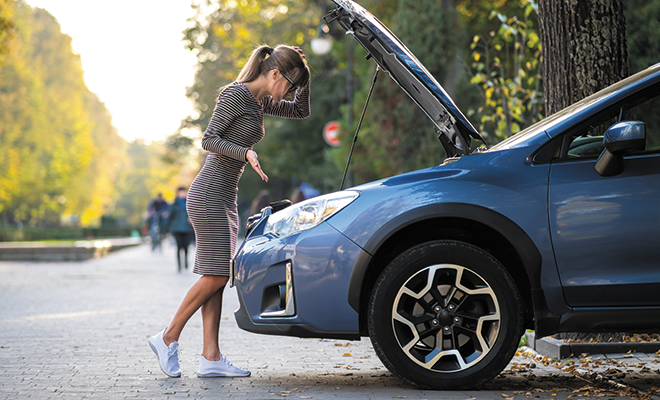
If you feel safe, prop up your hood to signal a breakdown. If you have reflective triangles or flares, place them at least 100 to 300 feet behind your vehicle, but only if you can do so safely away from traffic.
Determine your location.
This can be a mile marker, an intersection you have passed or the location of your vehicle on a smartphone app. Pay attention to whether you are southbound, northbound, eastbound or westbound. This will help the repair or tow service locate you. If you think there’s help within walking distance and you can safely get there, or you decide to leave your car unattended for any reason, lock the car and leave a note on the dashboard that includes your first name, cell phone number, destination and the time you left.
Change the flat?
General advice is to change the tire only if you’re away from traffic and only if the tire is on the side away from traffic. If it’s on the side facing traffic, it’s safer to call for help and let a professional do this for you. She will know where to find the spare tire, if the spare is properly inflated and if the flat tire needs a key to remove it from the vehicle.
Now that you’re safely back on the road, the next stop is your friendly local tire retailer. Replace the blown tire with a high-mileage new tire with road hazard coverage and make sure the spare goes back into the trunk where it belongs. That’s exactly what I did!
Sources: progressive.com, google.com, allstate.com and nationwide.com.
Be Prepared for Emergencies
Basic items to keep in your car or trunk can help in case of a car emergency. Based on your driving destinations and potential weather conditions, consider these for your safety kit. This also includes keeping a sticker on your windshield to remind you of oil changes and tire rotation dates.
• Cell phone with charger
• Notebook and pencil
• Vehicle operating manual
• Emergency service info, such as phone numbers
• Flashlight and extra batteries
• Drinking water and preserved food
• Jumper cables
• Tire-pressure gauge
• Reflectors or flares
• Signal flag or reflective vest or scarf
• Coolant
• Fire extinguisher
• Heavy gloves
• Thermal or safety blanket
• A chemical heat source such as hand warmers
• Candles and waterproof matches
• Jack and a flat board for soft surfaces
• Lug wrench for changing flats
• Toolkit with screwdriver, pliers, duct tape and adjustable wrench
• Umbrella
• Extra fuses and fan/alternator belt
• First-aid kit
• Spare tire and tire key